17 November 2006
Deal or No Deal
More news in the world of corporate expansion on the Internet. This time it's about News Corporation and its wunderkind who brokered the deal on MySpace.


13 November 2006
The Cons of Piracy
I want to point to a post on My Left Nutmeg that may support my crazy conspiracy theories about John Kerry, fed by new information about Joe Lieberman.
To backtrack, I won an award for my paranoid delusions two year ago during the 2004 presidential election. One of my more out-there theories was that John Kerry's membership in the über-exclusive Skull & Bones Society at Yale (Dubya is also a member) trumped his membership in the Democratic Party. I could formulate a hypothesis that Kerry finagled his way into the Democratic nomination, only to throw the election at the end. I felt, you see, that he conceded way too easily, and that after the 2000 debacle, the fact that he wouldn't even entertain a recount seemed fishy to me. I thought that he might have been working for the Republicans all along.
And let me just mention Kerry's bizarre "botched joke" episode at a very sensitive time in the campaign. Kerry could have made it all go away much more quickly than he did. Was this another attempt by Kerry to taint the public's view of the Democratic Party--by making misleading statements, as a Democratic representative, and also by reminding us of all the negative imaging surrounding his own 2004 campaign, by bringing attention to himself?
NOW, we have the suspect Democrat, Joe Lieberman. Read about his turnabout here on My Left Nutmeg. This article sheds some light on some very conservative congressmen who were elected as Democrats only to abandon the party shortly thereafter. It seems awfully underhanded to pull this sort of sleight-of-hand.
I'm only here to put out ideas to chew on, my friends. It is the responsibility of the crown.
To backtrack, I won an award for my paranoid delusions two year ago during the 2004 presidential election. One of my more out-there theories was that John Kerry's membership in the über-exclusive Skull & Bones Society at Yale (Dubya is also a member) trumped his membership in the Democratic Party. I could formulate a hypothesis that Kerry finagled his way into the Democratic nomination, only to throw the election at the end. I felt, you see, that he conceded way too easily, and that after the 2000 debacle, the fact that he wouldn't even entertain a recount seemed fishy to me. I thought that he might have been working for the Republicans all along.
And let me just mention Kerry's bizarre "botched joke" episode at a very sensitive time in the campaign. Kerry could have made it all go away much more quickly than he did. Was this another attempt by Kerry to taint the public's view of the Democratic Party--by making misleading statements, as a Democratic representative, and also by reminding us of all the negative imaging surrounding his own 2004 campaign, by bringing attention to himself?
NOW, we have the suspect Democrat, Joe Lieberman. Read about his turnabout here on My Left Nutmeg. This article sheds some light on some very conservative congressmen who were elected as Democrats only to abandon the party shortly thereafter. It seems awfully underhanded to pull this sort of sleight-of-hand.
I'm only here to put out ideas to chew on, my friends. It is the responsibility of the crown.
From Today's Reading
Here's an example of how the media work together:
Despite the high percentage of traffic that goes to the top handful of websites, the internet is still a medium of niches rather than a mass medium. If you want to persuade a mass audience, particularly a geographically concentrated one, television is your tool of choice, supplemented by radio, press outreach, direct mail and robo-calls.
Despite the high percentage of traffic that goes to the top handful of websites, the internet is still a medium of niches rather than a mass medium. If you want to persuade a mass audience, particularly a geographically concentrated one, television is your tool of choice, supplemented by radio, press outreach, direct mail and robo-calls.
Media Ecology
My colleague here at Colorado College mentioned an interesting conference she attended recently with the Media Ecology Association. She explained media as an ecosystem in which the parts support each other, instead of replace each other. Television, for instance, does not replace radio, but rather can work in conjunction with it. This may give us a way to look at blogging and online communication and how it fits with more traditional media. Are we moving towards an electronic world of communication that leaves print behind? Or will online media integrate with already existing media? How will that happen? Is the adoption of online production of television shows an example of this? NBC's announcement of reallocating financial resources from traditional, script-driven televised content to explore online possibilities may point to an answer.
Media Ecology as defined by three scholars on the MEA website (I took excerpts from longer definitions):
Media Ecology as defined by three scholars on the MEA website (I took excerpts from longer definitions):
It is the study of media environments, the idea that technology and techniques, modes of information and codes of communication play a leading role in human affairs.
—Lance Strate, “Understanding MEA,” In Medias Res 1 (1), Fall 1999.
One such perspective, or emerging metadiscipline, is media ecology—broadly defined as the study of complex communication systems as environments.
As a perspective, metadiscipline, or even a field of inquiry, media ecology is very much in its infancy.
Media ecology is, in short, a preparadigmatic science.
—Christine Nystrom, Towards a Science of Media Ecology: The Formulation of Integrated Conceptual Paradigms for the Study of Human Communication Systems, Doctoral Dissertation, New York University (1973).
Media ecology looks into the matter of how media of communication affect human perception, understanding, feeling, and value; and how our interaction with media facilitates or impedes our chances of survival.
The word ecology implies the study of environments: their structure, content, and impact on people.
An environment is, after all, a complex message system which imposes on human beings certain ways of thinking, feeling, and behaving.
- It structures what we can see and say and, therefore, do.
- It assigns roles to us and insists on our playing them.
- It specifies what we are permitted to do and what we are not. Sometimes, as in the case of a courtroom, or classroom, or business office, the specifications are explicit and formal.
In the case of media environments (e.g., books, radio, film, television, etc.), the specifications are more often implicit and informal, half concealed by our assumption that what we are dealing with is not an environment but merely a machine.
Media ecology tries to make these specifications explicit.
It tries to find out what roles media force us to play, how media structure what we are seeing, why media make us feel and act as we do.
Media ecology is the study of media as environments.
—Neil Postman, “The Reformed English Curriculum.” in A.C. Eurich, ed., High School 1980: The Shape of the Future in American Secondary Education (1970).
Toilet Paper
So, I was just standing at the urinal in the Colorado College Library and there, in front of my face, was a newsletter put out by the Career Center entitled "Toilet Paper." Great for short bursts of reading whilst producing short bursts of—OK, I'll stop there.
The interesting and relevant fact I learned during that trip to the loo is that the number one language used by bloggers is Japanese, followed by English at number two and Chinese at number three.
I'll report back if I learn anything else worthwhile next time I have to take a leak.
The interesting and relevant fact I learned during that trip to the loo is that the number one language used by bloggers is Japanese, followed by English at number two and Chinese at number three.
I'll report back if I learn anything else worthwhile next time I have to take a leak.
Forgive Me
I have been absent from the online community of TrinBlogWarriors. I have been on a recruiting trip along the West Coast for the last two weeks. I will return to New York tomorrow, flying in from Colorado. As I stayed almost exclusively with friends along the way, the alone-time I usually get in hotels has been scant. My sit-and-absorb-jewels-from-the-Web time has been limited. I have been following along as best I can, but have been conspicuously absent from discussions. I am very disappointed to miss tonight's class. It sounds like it will be a blast. At least there'll be an extra chair, so the boys from the L-L campaigns can sit next to each other again.
02 November 2006
From the Harvard Boy
This article from The Harvard Crimson, a contribution to our class edification, came my way from my brother.
It is entitled:
I'm in Seattle now, by the way.
It is entitled:
Panel Discusses Blog Effects
Experts predict coexistence of blogs and traditional media possibleI'm in Seattle now, by the way.
01 November 2006
Grey Gardens

PLEASE find the documentary "Grey Gardens" and WATCH IT.
I finally saw it last week in anticipation of seeing the new musical based on it, now playing on Broadway. My friends were aghast that I, of all people, had not seen this film.
It is about Mrs. Edith Bouvier Beale and her daughter "Little" Edie Beale. It is FASCINATING. They are cousins of Jackie O. and went from glamour and the heights of the society pages to becoming recluses in their dilapidated mansion in Southampton. It is FASCINATING.

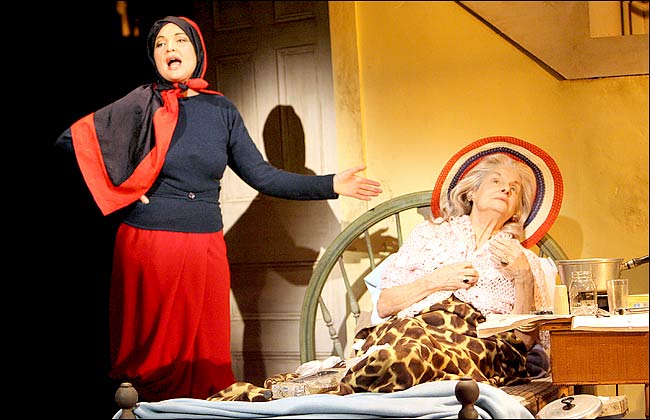
I just saw the musical last night. Christine Ebersole was just incredible.
Here she is playing Edie (with Mary Louise Wilson as Edith):
It's amazing what you can get done sitting in yet another airport.
That's Blog-Out-Loud Funny!
Yeah, Teach, good question. What type of humor do we go to the Internet for? Perhaps it is personal story-type humor. Funny blogs. The out-of-nowhere zingers from Dooce, for example. Sure, you can get that from real people, but these are people/writers we don't have in our midst. Perhaps they offer us a different type of humor than our friends do. Friends in real life and friends on TV. We may pee from a good dose of Amy Sedaris on David Letterman or South Park, but we're not friends with Cartman. And we can't see him anytime we want. With blogs and such, we can visit and laugh (or pee) whenever we feel like it. It's an instantaneous good time.
Perhaps it's no longer: "For a good time, call..." but "For a good time, visit www...."
Perhaps it's no longer: "For a good time, call..." but "For a good time, visit www...."
The Dangers of Blogging
That wad Senator George Allen (R)-Virginia is apparently just a thug.
Was he just acting in accordance with the Administration's policy against free speech? (I should clarify that the Bush Administration doesn't have an outright policy outlawing free speech, but they sure don't like people asking them tough questions or expressing contrary opinions.)
Was he just acting in accordance with the Administration's policy against free speech? (I should clarify that the Bush Administration doesn't have an outright policy outlawing free speech, but they sure don't like people asking them tough questions or expressing contrary opinions.)
30 October 2006
Yikes via NewsCloud
This post was on NewsCloud. A NYC journalist was killed in Oaxaca City, Mexico.
I guess this is the difference between NewsCloud and BoingBoing (A Directory of Wonderful Things).
I guess this is the difference between NewsCloud and BoingBoing (A Directory of Wonderful Things).
BoingBoing
Read BoingBoing's linking policy. It's terrific.
And following the links offers a further understanding of the do-we-call-it-paranoia, or just plain fear of this "new" medium? We discussed in class the value of Wikipedia and subsequently the value or weight or legitimacy of Internet research. We are clearly headed into the electronic age, no? So, when will the information contained (what a funny word to use in the context of the vast and unregulated, unfettered world of the Internet) online become legitimized? Will it?
I remember when we first started using the Internet and most people believed the information found online to be untrustworthy. We still believed that print was where it's at. People could be quoted as saying, "Well, I found it on the Internet. So, who knows?" The idea that anybody could put anything up on the World Wide Web somehow cheapened the information. Now, I believe, the sentiment is still prevalent but we have begun to accept the direction our information spreadin' is headin'. People get their news from the Internet. They book vacations that actually materialize (in real life!) on the Internet. They realize they have access to zillions of pieces of unnecessary information. No matter who put it there, the fact that we can hear the real voices of Alvin and the Chipmunks makes us feel more powerful. Immediacy of information.
I believe it promotes learning. Now, we can walk to the gigantic electronic library in our living room to answer any question (big or small) in an instant. We no longer let learning opportunities pass us by. Heard 1.65 billion (dollars to buy YouTube) times a day: "We'll google it." [Funny that "google" flags the spell-checker on the Google-owned Blogger.]
Back to the paranoia of unregulated systems, though. Is that it? Is it the new frontier with no rules, or rules made up by whoever makes them? When the government was toppled in Iraq and the warlords took over—making rules, commandeering people's cars at gunpoint because they could, killing citizens, who just sold their properties so they could leave the country, in order to steal the sale money—this was frontierland. It is scary. When you need to be constantly vigilant about your listing on Wikipedia because anybody could just poke in there and change it or even delete you from the annals of Wikihistory, this is not a peaceful world. While the lack of regulations might allow for freewheeling outlaws, it still allows our own personal freedoms—of speech, for example. And we see now that certain protocols are falling into place, or are at least being played with. I mentioned the next step in the evolution of wiki software (found in Urban Dictionary) as a rating system for entries, which moved the most "agreed upon" entries to rise to the surface. This doesn't necessarily guarantee accuracy. I mean, look at my pet peeve surrounding the phrase "Could care less." If we went with the most "agreed upon" usage, it would be wrong.
Where have I landed? I have no idea, but to say that this medium is exciting, ever-changing, evolving. We are learning-by-doing here, my friends.
And following the links offers a further understanding of the do-we-call-it-paranoia, or just plain fear of this "new" medium? We discussed in class the value of Wikipedia and subsequently the value or weight or legitimacy of Internet research. We are clearly headed into the electronic age, no? So, when will the information contained (what a funny word to use in the context of the vast and unregulated, unfettered world of the Internet) online become legitimized? Will it?
I remember when we first started using the Internet and most people believed the information found online to be untrustworthy. We still believed that print was where it's at. People could be quoted as saying, "Well, I found it on the Internet. So, who knows?" The idea that anybody could put anything up on the World Wide Web somehow cheapened the information. Now, I believe, the sentiment is still prevalent but we have begun to accept the direction our information spreadin' is headin'. People get their news from the Internet. They book vacations that actually materialize (in real life!) on the Internet. They realize they have access to zillions of pieces of unnecessary information. No matter who put it there, the fact that we can hear the real voices of Alvin and the Chipmunks makes us feel more powerful. Immediacy of information.
I believe it promotes learning. Now, we can walk to the gigantic electronic library in our living room to answer any question (big or small) in an instant. We no longer let learning opportunities pass us by. Heard 1.65 billion (dollars to buy YouTube) times a day: "We'll google it." [Funny that "google" flags the spell-checker on the Google-owned Blogger.]
Back to the paranoia of unregulated systems, though. Is that it? Is it the new frontier with no rules, or rules made up by whoever makes them? When the government was toppled in Iraq and the warlords took over—making rules, commandeering people's cars at gunpoint because they could, killing citizens, who just sold their properties so they could leave the country, in order to steal the sale money—this was frontierland. It is scary. When you need to be constantly vigilant about your listing on Wikipedia because anybody could just poke in there and change it or even delete you from the annals of Wikihistory, this is not a peaceful world. While the lack of regulations might allow for freewheeling outlaws, it still allows our own personal freedoms—of speech, for example. And we see now that certain protocols are falling into place, or are at least being played with. I mentioned the next step in the evolution of wiki software (found in Urban Dictionary) as a rating system for entries, which moved the most "agreed upon" entries to rise to the surface. This doesn't necessarily guarantee accuracy. I mean, look at my pet peeve surrounding the phrase "Could care less." If we went with the most "agreed upon" usage, it would be wrong.
Where have I landed? I have no idea, but to say that this medium is exciting, ever-changing, evolving. We are learning-by-doing here, my friends.
27 October 2006
And the winner is...
As winner of the "Most Paranoid" Award in the 2004 Educational Extravaganza entitled, "Media and the Presidential Election," I faithfully serve my crown, uphold my mantle, carry my torch and point you all toward a New Yorker article that not only fulfills my outlook but examines meme theory at the same time:
The Wayward Press
Paranoid Style: How Conspiracy Theories Become News
by Nicholas Lemann
The New Yorker, 16 October 2006
Online confession: I haven't actually read it yet.
It's sitting here staring me in the face as I kill time in my cousins' apartment in Washington D.C. (of all places), which means I can't actually take it with me. I will do my best to read and retain its contents before my departure. I could not find it online at newyorker.com.
P.S. In my description above, I sound less like an award recipient and more like the Statue of Liberty.
The Wayward Press
Paranoid Style: How Conspiracy Theories Become News
by Nicholas Lemann
The New Yorker, 16 October 2006
Online confession: I haven't actually read it yet.
It's sitting here staring me in the face as I kill time in my cousins' apartment in Washington D.C. (of all places), which means I can't actually take it with me. I will do my best to read and retain its contents before my departure. I could not find it online at newyorker.com.
P.S. In my description above, I sound less like an award recipient and more like the Statue of Liberty.
It Should Happen To You
An article in last week's New Yorker about "The anxieties of YouTube fame."
(Look at me! I'm posting little ones!)
(Look at me! I'm posting little ones!)
Rebecca's Blood Runs Thick
My title plays on my discoveries in an article I mentioned in a previous post. Rebecca here gives us a history of the weblog. I am sure most of you encountered this in the MetaFilter About page.
CamWorld via About MetaFilter
I wanted to include a passage from an entry from CamWorld in his search for signs of intelligent life in the universe (thank you, Ms. Tomlin and Ms. Wagner) and his pursuit of the meaning of blog. He is declaring a slow-down of his blog, which is indicative of the evolution of the online journal:
This was written in 1999.
Here he writes about the future (our present):
I hope the weblog "craze" continues as more and more people discover the power of a regularly updated site that reflects their own unique personality. In a few years, it'd be neat to see the weblog format overtake the standard home page format with monster GIFs of people's cats, dogs, babies, and cars. But I doubt it will happen. It's taken us almost six years to get people to understand that home pages don't need to have every funny little GIF animation they've ever seen, or silly javascript rollovers, or even that crash-happy Java-based pong game. Focus more on the content and less on the glitz. As the Internet community and Geocities members realize that the reasons they've had only 102 hits on their page(s) in a year (100 of them from their own IP address), the quality of their online initiatives will go up as they begin to understand what is required to keep a regular audience happy and well-fed.
How far we've come. Here's a monster GIF of my baby.
In the long run, I believe that this is what you all want. Less senseless hype. Less gratuitous linking. Less focus on the sensationalistic journalism that's crowding our brains and turning them into mush. More focus on the truly exceptional content out there on the web that only a few of us manage to dig up. More personal essays. More professional essays. And yes, even the occasional rant.
You see, CamWorld is about me. It's about who I am, what I know, and what I think. And it's about my place in the New Media society. CamWorld is a peek into the subconsciousness that makes me tick. It's not about finding the most links the fastest, automated archiving, or searchable personal web sites. It's about educating those who have come to know me about what I feel is important in the increasingly complex world we live in, both online and off.
CamWorld is an experiment in self-expression. And that experiment is not over. Over the next year (or two or three), CamWorld will evolve into something more.This was written in 1999.
Here he writes about the future (our present):
I hope the weblog "craze" continues as more and more people discover the power of a regularly updated site that reflects their own unique personality. In a few years, it'd be neat to see the weblog format overtake the standard home page format with monster GIFs of people's cats, dogs, babies, and cars. But I doubt it will happen. It's taken us almost six years to get people to understand that home pages don't need to have every funny little GIF animation they've ever seen, or silly javascript rollovers, or even that crash-happy Java-based pong game. Focus more on the content and less on the glitz. As the Internet community and Geocities members realize that the reasons they've had only 102 hits on their page(s) in a year (100 of them from their own IP address), the quality of their online initiatives will go up as they begin to understand what is required to keep a regular audience happy and well-fed.
How far we've come. Here's a monster GIF of my baby.
MetaFilter Finds
So (I often seem to start a post with "so..."), I was poking around MetaFilter and I chose this link to follow. Enlightening article about the use of performance enhancing drugs. Does our teacher love MF because of its randomness? From counting the number of times your own name appears in online databases to slowing down the voices of Alvin & The Chipmunks to free hugs in New York City, apparently one can find anything, and I mean ANYTHING, on MetaFilter.
Please tell me you'll listen to the Chipmunks song. It's hysterical.
Please tell me you'll listen to the Chipmunks song. It's hysterical.
25 October 2006
Subscribe to:
Posts (Atom)